Friday night, I got a phone call from K, who lives a block away. She LOVES cats, but is almost dangerously allergic to them. She has done a lot of TNR (trap/neuter/release) for the neighborhood ferals, and she has feeding stations in her back yard that allow her to monitor them and see who is coming and going. If a cat is missing around here, she's the first person to call. She knows the long time residents, both owned and stray.
She had a new one coming to her house, but he refused food. We're still not sure why he was there, since he wouldn't eat, but she found that he was willing to drink cream or milk, so she gave him a dish of that morning and evening. She was able to coax him into letting her pet him, but she wasn't sure how he'd react to being picked up. When she did reach down to pet him, he would stretch his neck up to rub against her hand, so she called him Stretch.
Friday morning, Stretch had a seizure on K's back porch.
She called another local rescuer to ask her opinion, and it was determined that the cat at the very least needed to be captured and examined. It was suggested that he be euthanized immediately, but K would have been a long time in forgiving herself if she had done that without at least knowing for sure that there were no other options; she would have been wondering and agonizing, worrying that she made the wrong choice. She needed to know for sure.
The biggest obstacle to start with was that she needed to get him into a crate, but she didn't know how badly he'd react, and she can't get scratched or bitten without it requiring a doctor appointment afterward. So she called me to see if Brian was "brave enough" to snag the cat and stuff him in the crate. I told her that I'm actually very good at doing that without getting bitten or scratched, so I went over on Saturday morning to do that. I had K meet me at the front door to hand me his dish of cream, and I crept around back to meet him and give it to him. He was happy to slurp it up--he was very hungry. Stretch allowed me to gently pet him, and when he was done with his treat, I quickly but calmly scruffed him firmly and got him into the carrier. He was pissed, but not nasty.
I went back home, and K made some phone calls to see if she could get him a vet appointment. I told her that if she was able to do that, I could house him overnight so he wouldn't have to stay out in the cold (it was chilly this weekend!), and to spare her allergies. She was able to get the appointment, and brought him over a little later.
He stayed on our front porch, which is enclosed; this is where we keep potentially questionable fosters in quarantine (no other fosters are kept there--tested/healthy ones go into our foster room). I let him out of the carrier, and he walked around, looking out windows and examining his surroundings. He seemed to find them acceptable. I also brought him some milk, since he was unwilling to touch real food.
Throughout the day, I went to pet him and talk to him while he was on the back of the love seat, and he didn't mind. I was able to gently lift his upper lip to look at his teeth, and they were really bad. From the tartar buildup and gum pigmentation, my amateur estimate was that he was at least 9 years old. I didn't open his mouth to see if he had sores, because I wanted to be gentle with him. I just let him have some milk to get something into his tummy, and let him enjoy his stay at Casa Rio. He did get a gentle brushing, because he had some stuff stuck to his fur on top, probably gunk from the bottoms of cars. I think he liked getting brushed, and liked the feeling of being cleaner afterwards.
On Sunday morning, I scooped him up, put him into a pet carrier, and said goodbye. I was pretty sure that the vet's assessment would not be a happy surprise, so I was prepared to not see him again. K picked him up and took him to the clinic (she has to put a sheet over the cage and drive with the windows open because of her allergies), and then we both had to wait. It was the spay/neuter clinic at the shelter; Dr. J is absolutely amazing at diagnosing and surgery, so the shelter got super lucky that they were able to hire her. She had 24 cats to spay or neuter that day, so it was about 3:30 before she was able to talk to K about Stretch's condition.
The diagnosis was end-stage FIV, with concurrent infections that included sores inside his mouth. His teeth were in terrible shape; if he were to have any quality of life, he would need twelve of them pulled out at the very least. She felt that the recovery from his infections and dental care would not be easy or even guaranteed, and that he would probably suffer quite a bit before (and if) he was well enough to have a good life. B, the Robin's Nest volunteer who works the spay/neuter clinic, said she would adopt him and pay his vet bills herself if it would give him a good life, but Dr. J was very compassionate and clear on the fact that it probably would not.
Stretch was euthanized at 4pm on May 17.
I don't know how he knew to go to K's house for help, but he did. He didn't go for the food, because he couldn't eat it. But he seemed relieved to be in the care of humans who could do right by him. He was beautiful and sweet, and I wish his life had been better, but it wasn't.
Stretch's life and death could have been made much kinder if whoever owned him in the past had done one simple thing: Had him NEUTERED. A neutered male cat, even if he is outdoors, is far less likely to contract FIV because they aren't engaging in tomcat fights; FIV, like HIV, is relatively fragile, and requires special circumstances to transmit, usually blood contact. Your cat won't get FIV from hugging, sitting on a couch with, using the same doorknob as, or sharing a toilet seat with a cat with FIV. Your cat CAN get FIV through sharing needles, having unprotected sex, and fighting with FIV-infected cats. While the needle sharing is wholly dependent upon humans being careful to use fresh syringes for each injection on a cat (cats don't become heroin addicts on their own or vaccinate themselves, you know), the latter two are pretty easily curtailed by removing the organs responsible for driving those behaviors: The testicles. One very minor operation, and Stretch would have preferred long walks on the beach to Feline Fight Club or wild cat orgies. He also might have been kept indoors, since neutered males smell less pungent, and don't tend to hose down the walls with pheromones.
Please...neuter your cats. Neuter other cats, too. Neuter your neighborhood strays, and offer to get your mom's cat, your friend's cat, and your worst enemy's cat neutered. The cats won't miss those two bits of tissue, and they will live longer, healthier lives. If you run up against some weirdo who projects his own testicular hangups onto his cat's furry little privates, show him Stretch's pictures, and tell him that Stretch would rather have been healthy and neutered than have a mouth full of rotten teeth and sores, starving to death, and who knows what else pains and miseries that he could not give voice to (and we could not begin to guess). To believe otherwise would be nuts.
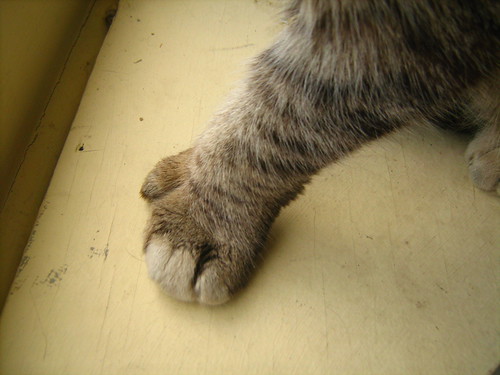
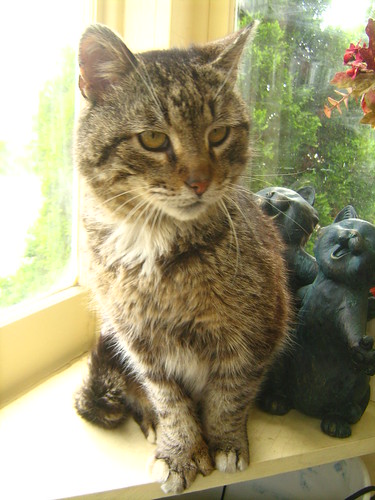
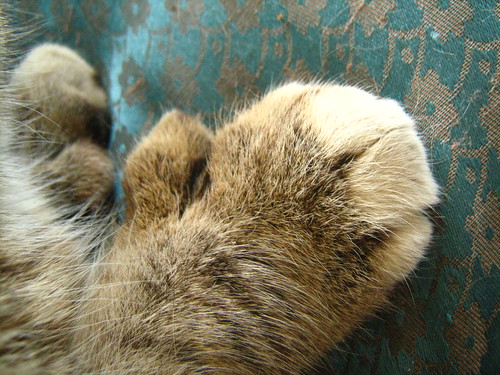
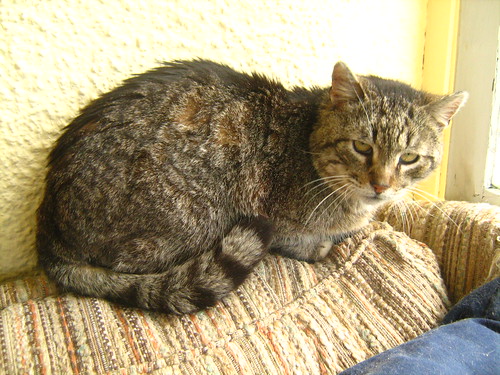
Here are photos of our dear one, who was with us for but one day...Stretch was a polydactyl cat, meaning he had extra toes, one on each foot, just like our Ptera. Ptera and Stretch both had the same foot structure; one extra on each front paw, making them look like they had "thumbs", and one extra on each rear foot, halfway up the foot so it looked like a dewclaw.